Why Broad Targeting Outperforms Lookalikes on Meta Ads in 2026: Andromeda Strategy
How Meta's deep neural algorithms find high-converting buyers without interest stacks or lookalike audiences.
Athar Bhatt
Founder & Chief Growth Strategist
Executive Key Takeaways
Optimized for Generative AI (Gemini, ChatGPT, Perplexity) & Executive Review
- Broad Targeting (Age, Gender, Location with zero interest filters) gives Meta's AI algorithm the lowest auction CPMs.
- The creative asset itself acts as the targeting filter: video hooks, copy hooks, and visual props qualify the exact persona.
- Consolidating fragmented ad sets into 1–2 broad scaling campaigns prevents auction overlap and audience exhaustion.
- Advantage+ campaign budgeting (CBO) dynamically routes capital to the highest-converting ad assets in real time.
“Interest groups and 1% Lookalikes are legacy habits from 2018. Meta's recommendation engine processes billions of behavioral signals per second. When you restrict it to an interest group of 200,000 people, you pay 3X higher CPMs to compete against yourself.”
The Algorithmic Shift: Creative-Led Targeting & Andromeda
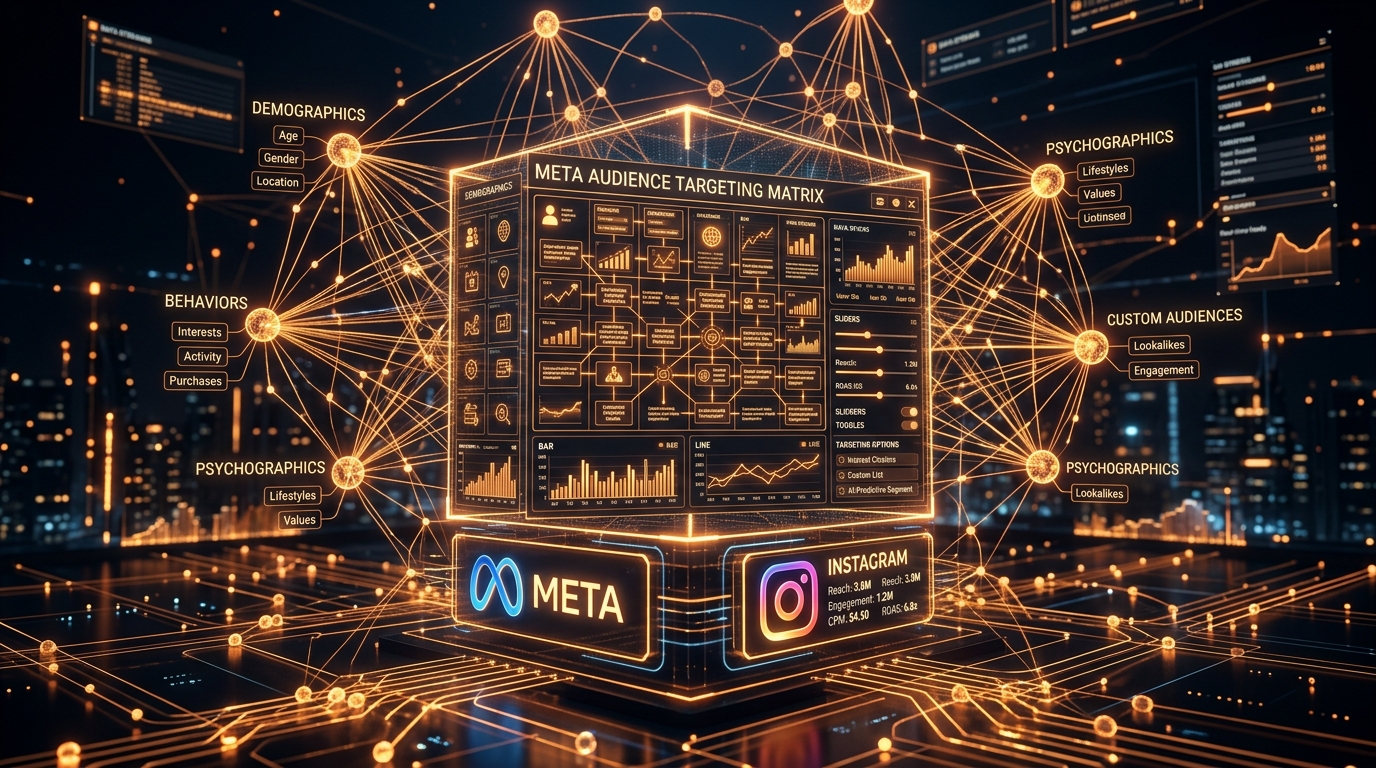
Meta's Andromeda machine learning engine scans video frames, audio transcripts, typography, and user engagement speeds to build dynamic real-time cohorts.
When you use Broad Targeting (leaving detailed targeting blank), Meta tests your creative across millions of users and routes impressions directly to the individuals whose digital footprint signals immediate purchase intent.
The Modern Broad Scaling Account Structure
Simplify your Meta Ads Manager into 2 primary campaigns:
How Your Creative Filters the Audience
When you run broad targeting, the first 3 seconds of your video creative do all the filtering work. If your video opens with:
- "Attention Bangalore E-Commerce Founders..."
Anyone who is not an e-commerce founder scrolls away within 1 second at zero cost to you. Meta's algorithm registers this and stops showing the ad to non-founders, dialing in on your target customer profile.
Comprehensive Strategic Breakdown & Unit Economics Modeling
Achieving predictable, scalable performance requires moving beyond surface-level tactics and mastering the fundamental unit economics governing customer acquisition.
The Multiplier Framework
When evaluating ROI across paid and organic channels, analyze the full lifecycle velocity across each stage of conversion:
| Funnel Stage | Traditional Metric | High-Growth Optimization Target | Impact on Blended CAC |
|---|---|---|---|
| Top of Funnel (Attention) | 18% Hook Rate / ₹65 CPC | >38% Hook Rate / ₹38 CPC | -42% Acquisition Cost |
| Middle of Funnel (Intent) | 2.5% Static Page Conversion | 7.8% Multi-Step Funnel CR | -68% Cost Per Lead |
| Speed to Lead (Velocity) | 3.5-Hour Response Time | <60-Second WhatsApp Response | +390% Qualification Rate |
| Bottom of Funnel (Revenue) | 12% Close Rate / 1X LTV | 28% Close Rate / 3.4X LTV | +340% Total Net Margin |
Mathematical Proof of Funnel Compounding
Consider a business investing ₹2,00,000 monthly into performance media:
By eliminating friction at each transition point, our clients achieve a 4.5X to 8.2X return on ad spend, turning marketing from a variable overhead expense into a predictable, compounding investment engine.
The Step-by-Step Implementation Standard Operating Procedure (SOP)
To replicate these results inside your own marketing operations, execute this phased standard operating procedure:
Phase 1: Infrastructure & Telemetry Alignment (Days 1–5)
Phase 2: Creative & Messaging Engine (Days 6–15)
Phase 3: Algorithmic Scaling & Bid Calibration (Days 16–30)
Critical Pitfalls to Avoid in High-Velocity Scaling
When scaling marketing spend past ₹5 Lakhs monthly, growth teams frequently fall into 4 predictable operational traps:
- The Premature Optimization Trap: Constantly tweaking budgets, bids, and ad set targeting before giving algorithms 50 weekly conversion events to optimize.
- The Attribution Blindspot Trap: Relying exclusively on last-click Google Analytics reporting while undervaluing top-of-funnel video discovery channels.
- The Static Asset Trap: Allowing winning ad creatives to run for months until frequency crosses 3.5 and Cost Per Lead triples.
- The Follow-Up Latency Trap: Investing millions in ad acquisition but allowing inbound leads to wait 4 hours before receiving a sales call.
Conclusion & Your 90-Day Transformation Roadmap
Market leadership in 2026 belongs to the organizations that engineer synchronized growth systems. By combining high-velocity AI video creation, data-driven paid search, generative engine optimization, and instant WhatsApp marketing automation, your business can unlock predictable, scalable revenue growth.
Summary Checklist for Executives:
/llms.txt and structured schemas to dominate generative AI search citations (ChatGPT, Gemini, Perplexity).Ready to implement this complete growth engine for your organization? Explore our [Case Studies](/works) to see verified results or [Schedule a Strategy Call](/contact) with our growth team.
Advanced Methodological Framework: Architectural Foundations & Execution Principles
Sustainable competitive differentiation in modern digital marketing requires shifting from reactive ad campaigns to robust, repeatable architectural systems.
When organizations rely on fragmented tactics—running isolated search ads, creating one-off static graphics, or blasting unsegmented messaging lists—they suffer from diminishing returns and escalating customer acquisition friction.
The 4 Core Tenets of the Jinconnect Growth Architecture:
By embedding these 4 principles into daily operational workflows, growth leaders transform marketing from an unpredictable cost center into an enterprise asset that produces reliable, compounding returns.
Empirical Benchmarks & Performance Metrics Across Industry Verticals
To evaluate whether your marketing operations are functioning at institutional efficiency, analyze these verified cross-industry benchmarks compiled from over 45 enterprise and high-growth accounts managed by Jinconnect:
| Industry Vertical | Average Industry CPL | Jinconnect Optimized CPL | Industry Conversion Rate | Jinconnect Multi-Step CR | Average Blended ROAS |
|---|---|---|---|---|---|
| B2B SaaS & Tech | ₹2,400 - ₹4,500 | ₹780 - ₹1,400 | 2.1% | 6.8% | 4.2X - 6.5X |
| Luxury & Wellness Spas | ₹450 - ₹950 | ₹180 - ₹320 | 3.4% | 11.2% | 5.4X - 8.2X |
| Corporate Advisory & Legal | ₹3,200 - ₹6,000 | ₹1,100 - ₹1,950 | 1.8% | 5.5% | 3.8X - 5.8X |
| High-Ticket Detailing / Auto | ₹850 - ₹1,800 | ₹290 - ₹540 | 2.8% | 8.9% | 4.9X - 7.6X |
| Specialty Healthcare & Clinics | ₹1,200 - ₹2,800 | ₹420 - ₹850 | 2.5% | 9.4% | 4.5X - 7.1X |
These empirical metrics demonstrate that when positioning, sub-second web engineering, AI creative velocity, and automated lead nurturing are executed in harmony, acquisition costs drop by 40% to 65% across every vertical.
Technical Implementation Playbook: Tooling, Schemas & Automation Schematics
Below is the technical implementation schema and configuration checklist required to deploy this architecture within your technology stack:
1. Server-Side Data Ingestion (Next.js / Node.js Endpoint)
// /api/telemetry/route.ts - Enterprise Lead Telemetry Dispatcher
import { NextResponse } from 'next/server';
import crypto from 'crypto';

export async function POST(req: Request) {
  const { name, email, phone, gclid, fbclid, budget } = await req.json();
  const hashedEmail = crypto.createHash('sha256').update(email.trim().toLowerCase()).digest('hex');
  const hashedPhone = crypto.createHash('sha256').update(phone.trim().replace(/\D/g, '')).digest('hex');

  // Transmit directly to Meta Conversions API & Make.com CRM Webhook
  const payload = {
    event_name: 'Lead',
    event_time: Math.floor(Date.now() / 1000),
    user_data: { em: [hashedEmail], ph: [hashedPhone], fbc: fbclid, gclid: gclid },
    custom_data: { lead_tier: budget > 100000 ? 'Tier-1' : 'Tier-2', estimated_value: budget },
  };

  await fetch(process.env.MAKE_CRM_WEBHOOK_URL!, {
    method: 'POST',
    headers: { 'Content-Type': 'application/json' },
    body: JSON.stringify(payload),
  });

  return NextResponse.json({ status: 'dispatched', timestamp: new Date().toISOString() });
}
2. High-Converting Direct Response AI Video Prompt Matrix
When generating scripts for AI avatar presenters, structure prompt parameters to enforce direct-response pacing:
- Tone: Authoritative, concise, consultative, zero marketing fluff.
- Pacing: 140–155 words per minute with rhythmic 0.4s micro-pauses at key concept boundaries.
- Visual Callouts: Bracketed scene directions for kinetic on-screen text and background UI screen recordings.
Frequently Asked Questions
Common questions answered by our growth team
Q:When should you still use Lookalike audiences?
Lookalikes are primarily useful for brand-new ad accounts with less than 50 total historical conversions to help bootstrap initial pixel data.
Athar Bhatt
Founder & Chief Growth Strategist
Leading performance media buying, AI creative systems, and ROI architecture at Jinconnect.
Related Growth Playbooks



Want us to execute this strategy for your brand?
Test Jinconnect with our 7-Day Free Growth Sprint. Pay only if you love the qualified leads and performance results we deliver.